


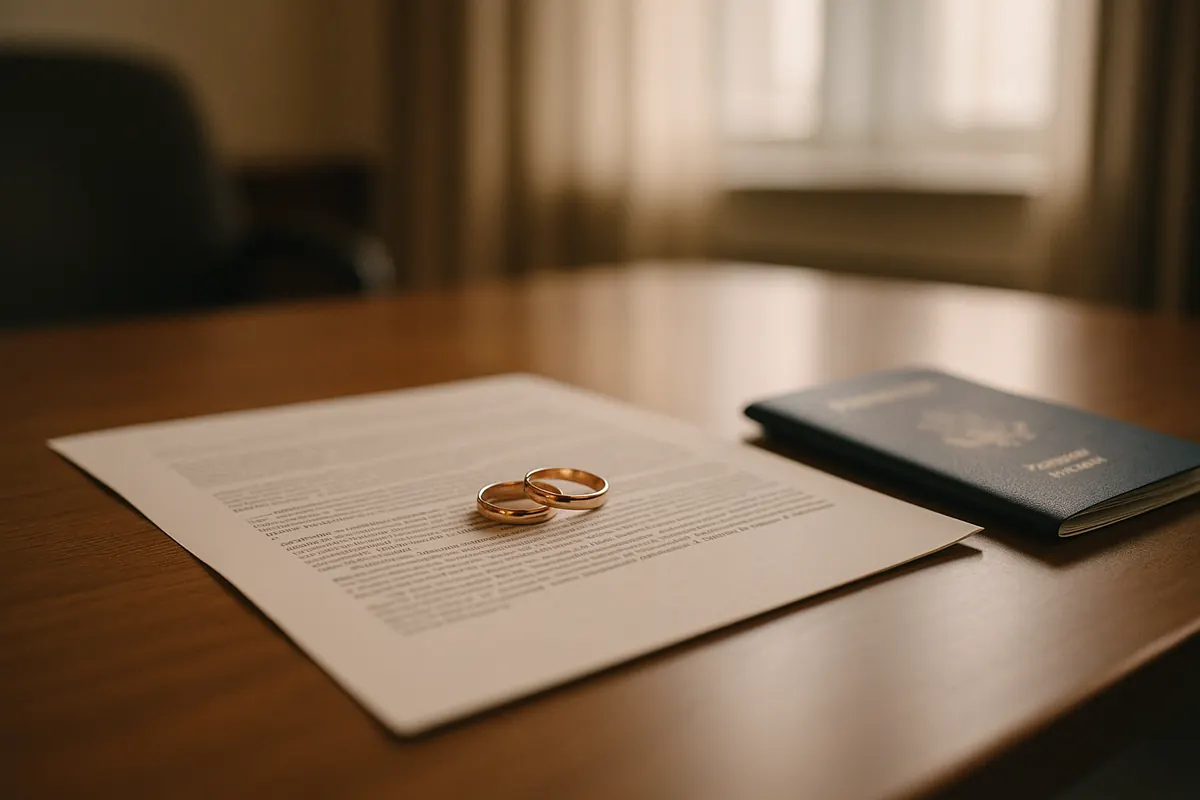
Quick Answer: What happens if a marriage ends while a green card case is still open? In most situations, divorce does not automatically shut down a marriage-based case, though the outcome depends heavily on timing. A conditional resident who divorces can usually keep moving forward by filing a waiver instead of a joint petition. Someone whose adjustment of status is still pending faces a harder path, since the qualifying marriage generally has to exist at the time of approval. A green card holder who already holds an unconditional, ten-year card keeps that status regardless of a later divorce — the only thing that changes is the timeline for citizenship, not the green card itself.
What the Green Card Process Looks Like When You’re Married
A marriage-based green card typically starts with a U.S. citizen or lawful permanent resident spouse filing Form I-130, followed by adjustment of status if the immigrant spouse is already living in the United States, or consular processing if they are abroad. If the couple has been married less than two years on the date the green card is approved, USCIS issues conditional permanent residence, valid for two years, rather than a standard ten-year card. That status comes with an extra requirement: filing a petition to remove the conditions before the card expires. Cases built around a documented spousal relationship generally move through USCIS on a faster timeline than most employment-based categories, but the relationship still has to remain genuine and provable at every stage that follows.
That head start is one of several reasons pursuing a family-sponsored case remains one of the most common paths to a green card, which makes it worth understanding exactly how a change like divorce interacts with the process from the very beginning.
Does Divorce Automatically End a Green Card Case?
There is no single rule that answers this question for every applicant, because immigration law treats marriage-based cases differently depending on how far along they are. USCIS is primarily concerned with whether a marriage was entered into in good faith — meaning two people intended to build a life together, not simply to obtain an immigration benefit — at the time it was formed. A later divorce does not, on its own, retroactively prove that the marriage was fraudulent. That said, officers do look more closely at cases where a marriage ends shortly after conditional residence or a green card is approved, since that timing pattern is one of several factors reviewed during standard fraud screening. A long, well-documented marriage that later ends is treated very differently from a brief marriage that dissolves within months of an approval.
Where You Are in the Process Changes Everything
The stage a case has reached at the moment of divorce determines which forms, waivers, or alternative paths are actually available.
Divorce Before Adjustment of Status Is Approved
If a divorce becomes final before an adjustment of status application is approved, the case usually cannot move forward on the original marriage-based petition, because the qualifying spousal relationship no longer exists at the point USCIS needs to confirm it. This is close to the scenario examined in a companion article on what happens after a spousal petition is denied, which walks through appeal and refiling options that may still be available. Depending on individual circumstances, alternatives can include a self-petition through the Violence Against Women Act if abuse was a factor, a hardship-based path for certain conditional residents, or pursuing an entirely different visa category. Anyone approaching this situation benefits from getting legal advice before finalizing a divorce, because the order in which the two processes happen can materially change the outcome.
Divorce After Conditional Permanent Residence Is Granted
Couples who marry less than two years before a green card is approved receive conditional status instead of a full ten-year card. If the marriage ends before that two-year period is up, the joint petition normally filed with a spouse is no longer an option. Instead, the conditional resident can request a waiver of the joint filing requirement using the official form USCIS provides for removing conditions on permanent residence, supported by evidence that the marriage was entered into in good faith even though it later ended. Unlike a joint filing, which must be submitted during the 90 days before the conditional card expires, a waiver request based on divorce can generally be filed at any time after the divorce is finalized, without waiting for that narrow window. Timing a divorce around an upcoming green card interview can still affect how smoothly this transition goes, which is one reason early planning matters.
Divorce After Conditions Are Removed or a Ten-Year Card Is Already Issued
Once conditions have been removed, or if the original green card was already unconditional because the marriage was more than two years old at the time of approval, the green card itself is secure. A later divorce does not put permanent resident status at risk. What does change is eligibility for certain shortcuts tied to an intact marriage, most notably the faster path to citizenship available to permanent residents who remain married to and living with a U.S. citizen spouse.
| Stage When Divorce Occurs | Effect on the Green Card Case | Typical Next Step |
|---|---|---|
| Before adjustment of status is approved | Case usually cannot proceed on the original marriage petition | VAWA self-petition, hardship waiver, or a different visa category, depending on circumstances |
| During the two-year conditional residence period | Joint filing is no longer possible | Waiver of the joint filing requirement, supported by good-faith marriage evidence |
| After conditions are removed, or an unconditional card is already issued | No effect on the green card’s validity | Nothing required for the green card; the naturalization timeline may change |
Proving the Marriage Was Entered Into in Good Faith
Because USCIS cannot ask a separated couple to keep demonstrating an ongoing relationship, the agency instead looks backward at documentation created while the marriage was intact. Strong evidence typically includes joint bank or credit accounts opened well before the separation, a shared lease or mortgage, joint tax returns filed for the years the couple lived together, children born during the marriage, insurance policies naming each other as beneficiaries, and sworn statements from family members or friends who knew the relationship firsthand. The rising volume of additional-evidence requests USCIS has issued across recent filing cycles makes it more important than ever to submit a complete, well-organized packet the first time, since a waiver filing that arrives with thin documentation is more likely to trigger a formal request for more evidence or a notice of intent to deny before a decision is reached.
How USCIS Distinguishes Divorce From Marriage Fraud
Marriage fraud — entering into a marriage solely to obtain an immigration benefit — carries serious and lasting consequences, but it is not the automatic assumption whenever a marriage ends. Officers weigh the length of the relationship, whether the couple actually lived together, the degree of financial entanglement, and the underlying reason the marriage ended. A short marriage that ends abruptly soon after conditional residence is approved tends to draw more scrutiny than a divorce that follows several years together. When a case does raise questions, a team experienced in responding to additional-evidence and intent-to-deny notices can make the difference between a case that stalls and one that reaches an approval, since the response needs to directly address whatever concern prompted the officer’s letter.
Special Circumstances That Change the Analysis
A handful of situations shift the standard rules described above. Immigrants who were abused by a citizen or permanent resident spouse may qualify to self-petition under the Violence Against Women Act, independent of the abusive spouse’s cooperation or knowledge — a path that generally remains open even after a divorce, provided the self-petition is filed within two years of the divorce and the marriage’s end is connected to the abuse. Someone who entered the country on a K-1 fiancé visa, married the petitioner within the required 90 days, and later divorces before adjustment of status is approved may still be able to obtain a green card through that marriage. Under controlling Board of Immigration Appeals precedent (Matter of Sesay), what matters is whether the marriage was bona fide when it was entered into — a later divorce, even one that happens before the case is decided, does not by itself defeat an otherwise-qualifying K-1 adjustment. That said, this scenario still requires careful documentation of the marriage’s good faith and should always be discussed with an attorney before assuming either outcome. Domestic violence waivers for conditional residents involve additional evidentiary standards beyond a standard good-faith waiver, and cases involving coercion or extreme cruelty should always be discussed directly with an attorney rather than handled alone.
How Divorce Affects the Path to U.S. Citizenship
Green card holders who remain married to and living with a U.S. citizen spouse can generally take the path toward U.S. citizenship after three years of permanent residence instead of the standard five. That shortcut depends on the marriage staying intact — if a divorce is finalized, or the couple stops living together, before the application is filed and approved, the three-year rule no longer applies. The green card itself is unaffected, but the applicant then has to wait out the full five-year period like any other permanent resident before filing, and USCIS will ask about marital history and current living arrangements during the interview itself.
Steps to Take If You’re Getting Divorced During Your Green Card Process
An assessment tool built to review the strength of a marriage-based case can be a useful starting point for gauging where things stand, but the following general steps apply across most situations:
- Talk with an immigration attorney before finalizing the divorce, if timing allows, so the case can be planned around the divorce rather than the other way around.
- Gather documentation of the marriage now, while joint accounts, leases, and records are still easy to collect.
- Identify which stage the case is in — pending adjustment of status, conditional residence, or an already-unconditional green card.
- File the correct form for that stage, whether that means a waiver request, a response to a pending evidence request, or nothing at all.
- Keep current immigration status valid throughout the divorce, since falling out of status can create a separate set of problems.
- Ask about options such as a VAWA self-petition if abuse played any role in the marriage or its ending.
Frequently Asked Questions
Will my green card be denied just because I got divorced?
Not automatically. What matters most is the stage of the case and whether the marriage can be shown to have been entered into in good faith, not the fact that it later ended.
Can I still get a green card if I divorce before my interview?
It becomes significantly harder, since the qualifying marriage generally needs to exist when adjustment of status is approved. Some applicants can pursue a VAWA self-petition, a hardship waiver, or a different visa category instead.
What is an I-751 waiver, and do I need one?
It is a request to remove the conditions on a two-year conditional green card without a spouse’s joint signature. Conditional residents who divorce before their two-year card expires typically need to file one.
Is there a deadline to file a divorce-based waiver?
Unlike a joint petition, which has a strict 90-day filing window, a waiver based on divorce can generally be filed at any time after the divorce is finalized, though filing promptly is still advisable.
Can I remarry and still keep my green card?
Yes. Once conditions have been removed or an unconditional green card has been issued, remarriage has no effect on that status.
Does divorce affect my path to U.S. citizenship?
It can. The three-year naturalization shortcut for spouses of U.S. citizens requires an intact marriage; after a divorce, applicants generally return to the standard five-year residency requirement.
What if my spouse was abusive — do I have other options?
Yes. A VAWA self-petition allows an abused spouse to pursue a green card independently of the abuser, including in many cases after a divorce connected to the abuse.
What evidence proves a marriage was genuine after a divorce?
Joint financial records, shared leases or mortgages, tax returns filed together, children born during the marriage, insurance beneficiary designations, and affidavits from people who knew the couple are all commonly used.
Divorce during a green card process is stressful enough without also worrying about immigration status, but in most situations the end of a marriage is not the end of the road. Whether the right next step is a waiver, a VAWA self-petition, or simply confirmation that an already-unconditional green card is unaffected, getting a clear read on the case early makes everything that follows far more predictable. The attorneys at Stelmakh & Associates Inc regularly guide clients in New York, San Francisco, Chicago, Austin, Miami, and Seattle through exactly this kind of transition, reviewing each case’s timeline and evidence before any forms are filed.